How to Deal with Foggy Windows


No matter what the climate is like where you live, keeping the temperature comfortable inside your car often means battling foggy windows. If you live in a climate with cold winters, staying warm in your chilly car means turning on the heater — and battling the resultant fog on the inside of your windows. In warm, humid areas, turning on the AC can cause the opposite issue — fog blurring your windows from the outside.


The reason for foggy windows has to do with temperature and the air’s moisture content. On a cold day, any moisture in the air inside your car — from passengers exhaling, from snow on your boots, etc. — turns to condensation when it hits air next to the windows that’s below a certain temperature, called the dew point. The condensation is what makes your car’s windows appear foggy. On a hot, humid day, the opposite happens, when the muggy air outside your car reaches the dew point against your windshield after it’s cooled by your AC system.
Whether the fog is on the inside or the outside of your windows, any time you can’t see clearly in all directions, it’s dangerous. So, it’s important to know how to make sure your windows are clear — no matter the weather.

When It’s Colder Outside Than Inside Your Car…

When you’re dealing with cold weather outside and you turn on the heater inside your car, the fog typically will start to form on the inside of your car windows. Here are some options to clear those windows up:
  • For a quick fix: Lower the temperature inside your car rapidly by turning on the defrost vent with cool air or cracking a window; don’t turn on the heat. This will make the inside of your car cooler and help reduce the fog. Also, turn on your car’s rear-window defogger to help clear up the back window. Though this is a fast and effective method, it could leave you shivering.
  • For a more comfortable solution: Lifehacker advises those who want to be snug and warm while driving to turn on the defroster and blow warm air across the windshield to evaporate the accumulating moisture. If your vehicle’s ventilation system has a recirculate feature, turn it off. When this feature is on, your car’s heat or AC reuses the air inside the car, instead of continually pulling in air from outside.  If you’re trying to defog the windows in cold weather, you want your car to continually take in the dry air. (Not sure if your car has recirculation? Look for a button on the dashboard that has an arrow going in a circle or a semi-circle. Sometimes, it will feature an icon of a car with this type of arrow inside it.)
  • Plan ahead: Keep your car glass as clean as possible — on the inside and the outside. That way, when your glass fogs up, you know the problem isn’t just a dirty windshield. You may also want to think about using a product that you can spray or wipe onto the inside of your windows in order to help prevent fog from forming.

When It’s Warmer Outside than In Your Car…

When the temperature and moisture level outside are greater than inside the car, moisture will condense on the exterior of the car glass. In this situation, the trick is to increase the temperature on the inside of the car to accumulate less moisture on the outside. Keep the following tips in mind:
  • For a quick fix: Use your windshield wipers. This will help get rid of the condensation until you’ve balanced out the temperature.
  • Warm up your car: Turn down the AC to the lowest (least-cool) setting to increase the temperature without it becoming too uncomfortable. If this doesn’t work, turn the AC off completely.
  • Leave recirculation off: As stated above, it’s a good idea to turn off your car’s recirculation feature to battle foggy windows, so the temperature and moisture levels in your car begin to equalize with those outside.
Trying to see through fogged-up windows is a driving hazard, but with these tips, you can help increase your driving safety—no matter what the weather.

Gas Tanks: Why Aren’t All Fuel Doors on the Same Side?


Quick: On which side is your vehicle’s fuel door?

Must you look at the little diamond-shaped arrow on the fuel gauge EVERY time you fill up to know which side holds the fuel filler? Have you ever pulled to the fuel island to discover you’re on the wrong side? Did you utter bad words before or after you said, “Why don’t they put fuel doors on the same side of every car?!?”

The answer to that question is complicated, if not convoluted.

Based on my research into the Federal Motor Vehicle Safety Standards, I came to the conclusion (a conclusion later supported by my contacts at both the Ford Motor Company and Nissan North America) that no U.S. government regulation concerns which side on which the fuel door must be positioned. Much to the chagrin of many motorists, the fuel door can be on either side.
With no legal or marketing motivation, and scant ownership enjoyment implications, car-company engineers are free to place fuel doors on whichever side offers the easiest packaging, according to Ford spokesman Mark Schirmer. He added that there’s not enough room — and no demand — for dual fuel doors.

Preference

Americans prefer left-mounted fuel doors, said Schirmer, referencing a Ford study. A driver’s-side fuel door makes it easier for drivers to place the car’s left fender close to fuel pump. Still, fuel door location is typically not part of the buying decision, added Schirmer.
Those in Japan, India, the United Kingdom, Australia, Hong Kong, New Zealand, and countries in southern Africa drive on the left side of the road and sit on the right side of the car, and it appears they prefer right-mounted fuel doors, given the tendencies of cra manufacturers. For at least 25 years, the conventional wisdom among auto writers has been that Europeans like right-side doors. However, when I posed this to my industry co-horts, no car company would speculate if or why that might be true.
Nissan, like most automakers, produces some vehicles with left fuel doors and some with right doors.

Reasons

“The placement of the fuel door is mainly a factor of fuel tank design, location and underbody packaging,” Nissan’s Steve Yaeger wrote in an email. “With all of the structure and components located underneath the vehicle, (engineers) would quickly encounter restrictions in trying to route the filler tube to the same side on every vehicle.”
If mechanisms such as a “big, honkin’ speaker” must be placed on the left side, engineers put the fuel door on the right, notes Schirmer.
The bottom line: Fuel door position is not a random choice, but if engineers have a good reason to place fuel doors on the right, that’s where they go.
If you can’t remember the location of your fuel door, don’t be ashamed to look at the little diamond-arrow on your fuel gauge … BEFORE you pull up to the pump.


DIY: How to Change Windshield Wiper Blades


Windshield wipers are an often overlooked part of your car's safety system. If your windshield wipers are not working properly, it can be difficult to see when it rains or snows. Faulty windshield wiper blades can smear your windshield, creating visibility hazards. So, it's important to make sure your wiper blades are in good shape.

What Needs To Be Done:

Windshield wiper blades need to be inspected and replaced, if needed, on a regular basis.

Why Do It?

  • Windshield wiper blades are made out of rubber, which can wear even with limited use.
  • By being certain that your windshield wiper blades are in optimum condition, you are ensuring the safety of your vehicle and its passengers.
  • If you are driving your car in pouring rain, snow or sleet, worn-out wiper blades can impede the wipers' ability to clean the windshield, which can limit your visibility.
  • Making sure your windshield wipers are newly inspected and replaced, if necessary, can help ensure safety.

How Often?

The frequency at which your windshield wiper blades need replacement depends, in part, on the conditions where you live and drive.Some general information is listed below, but always defer to your car owner's manual and the information that comes with your wiper blades for advice on maintenance.


Check? Replacement?
Sunny, Hot Climate At least every six months At least once yearly
Even if you use your wipers very little, the hot sun can damage the rubber on your wiper blades, making the wipers unusable,according to Autos.yahoo.com.
Cold Climate At least every six months At least once yearly
According to Autos.com, the grit and salt used in cold climates can wear out the rubber wiper blades quickly.
Dusty And Sandy Regions Every several months Every six months to a year
If you regularly drive in dusty or sandy areas, even if you don't use your wipers often, grit and sand can accumulate around and on the wiper blade, resulting in fast wear.


How to Do It:

Changing your wiper blades is simple. If you're unsure about your wiper blade-changing abilities, it's always a good idea to leave it to the professionals. This is something that is often done when you take your car in for an oil change, so ask your car dealership or quick-lube shop about it the next time you go in. But, if you want to do it yourself, you can follow these steps:

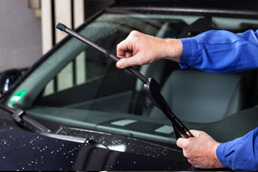
Step 1. Remove the old wiper.

How to check your wiper blades.
Lift the wiper arm away from the windshield, depress the small tab and slide the blade off the arm.
Lift the wiper arm away from the windshield and depress the small tab on the underside of the wiper where it meets the wiper arm. When the tab is depressed, slide the wiper blade off the arm by pulling the center toward the bottom of the arm.

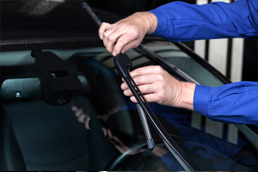
Step 2. Line up the new wiper blade with the arm.

Move the hook on the arm over the plastic clip on the new wiper blade.

Step 3. Pull it tight.

Replacing windshield wiper blades.
Attach the new wiper blade, making sure it clicks into place.
Pull the wiper blade tight onto the arm. You will hear a clicking sound when it clicks into place. Now, simply lower the arm slowly back onto the windshield and repeat this process on the other wiper arm.

Tips for Checking Your Tire Pressure


Proper maintenance of your car can be crucial for its long life and safe operation. Your tires are one of the most important parts of your car; literally the place where the rubber meets the road. Regular care and maintenance are crucial to the safe and reliable performance of your vehicle.


The air pressure inside your tires needs to be checked regularly to help ensure your vehicle runs smoothly and efficiently. Underinflated tires can contribute to increased wear and tear, and also reduce fuel efficiency, says Edmunds. Tires can lose air in a variety of ways, including a tiny hole, a leak on the the valve stem or an issue with the wheel on which it’s mounted, according to Popular Mechanics. In addition, changing temperatures can affect the air pressure of your tires. Tire pressure can vary 1-2 pounds per square inch (psi) for every 10-degree difference in ambient temperature, according to Goodyear. Keep in mind, it can be difficult to tell if a radial tire needs air just by looking at it, so tires should be checked.

When Should I Check?

Tires warm up when your car is moving. Air expands inside a “hot” tire, so the air pressure reading will likely not be accurate for a hot tire. Tire air pressure should be checked once a month when the tires are cold, says Edmunds. But, you may want to consider checking your tire pressure more frequently in the following instances, which may make the affect the pressure:
  • If you run over a sharp object, like a nail, that can puncture the rubber.
  • If you strike a curb or other object.
  • If the weather suddenly changes from warm to cold.
If your car has a tire pressure sensor and the light on the dashboard is illuminated, you should check the tire pressure immediately on all four tires, says Bridgestone.

How Should I Check?

Edmunds recommends some simple steps for properly checking tire pressure:

Step 1. Purchase a tire gauge. Tire gauges are small enough to fit in your glove box, and they’re a handy tool to have. The newer digital tire gauges can be more accurate — and easier to read — than the older ones. If you don’t want to purchase a gauge, you can go to the air pump at a gas station, which usually has a gauge on the hose. That’s convenient, because if you find that your tires need air, you’re already there.

Step 2. Discover the proper air pressure for your car. Tire pressure is measured in pounds per square inch, or psi. You can often find the right psi for your vehicle on a yellow sticker inside the driver’s-side door jamb, or you can consult your owner’s manual. Remember, the ideal air pressure may be different for the front and rear tires.

Step 3. Remove the air valve cap from your tire. It’s easy to lose this little valve cap. Be sure to place it in your pocket or someplace where it will not roll away or quickly disappear.

Step 4. Press the tire gauge against the open valve stem. You will hear a hiss of air as you press down. Don’t be concerned; this is normal.

Step 5. Read the air pressure gauge. The number will appear on the dial or digital screen on the tire gauge. Compare this number with the recommended tire pressure for the tire. If it’s too low, you can add air. If the pressure is too high, you can let air out of the tire.

The all-new #Ford GT Supercar’s Digital Instrument Display Is The Dashboard of The Future


Like the glass cockpit in airplanes and race cars, the all-new Ford GT features an all-digital instrument display in the car’s dashboard that quickly and easily presents information to the driver, based on five special driving modes.

The innovative 10-inch wide digital instrument display is far advanced from the original Ford GT, when the cockpit was hardwired with a fixed set of analog gauges, buttons and knobs across the dashboard that had to address almost every situation.

“Driver focus and attention are key with such high performance,” said Jamal Hameedi, chief engineer, Ford Performance. “We’ve designed the GT with a sleek digital instrument display that changes depending on driving mode in ways that are important and usable to the driver.”

Watch the video here - http://ow.ly/Zjey307WRYo

Ken Grody Ford Sale Special - New 2017 Ford Fusion SE


The 2017 Fusion is a testament to contemporary design. While its stunning, sculpted exterior has earned Fusion plenty of style cred, it’s more than just design for design’s sake. Fusion is equipped with thoughtful features like available smart driver-assist technologies and voice-activated controls. Driving one tells the world you know where you’re going. 

Ken Grody Ford Sale Special - 2017 Ford Explorer XLT


The power and driving dynamics of Explorer come wrapped in an eye-catching design that boasts authentic comfort and style. And because it was built for our modern active lives, you can also expect an interior space for the kids, the dog, the sports equipment, camping gear and just about everything else you may need on the road to adventure.

All-new F-150 Raptor wins Cars.com Best Pickup Truck 2017; F-Series Super Duty also nominated


The 2017 F-150 Raptor took home Best Pickup Truck of 2017 from Cars.com.

The all-new F-150 Raptor, building off the success of its predecessor, pushes the envelope more with performance gains and new technology offerings. With more power and torque, a first-in-class 10-speed transmission, a high-strength, military-grade, aluminum-alloy body that saves 500 pounds over the previous model, unique BFGoodrich tires and improved Fox Racing shocks, the 2017 F-150 Raptor stands alone in the high-performance off-road truck segment.

The redesigned, reengineered 2017 Super Duty also vied for the overall award. Boasting 20 class-exclusive features and a host of best-in-class claims, including most towing capability, payload and torque, the all-new F-Series Super Duty is the toughest, smartest, most capable Super Duty ever.

We would love to hear from you!

Please take a few minutes to leave us a review of your experience with us here. Thank you for helping us improve our business!

Nighttime Driving Worries

This year, Daylight Savings fell on November 6 – the day we all set our clocks back an hour, officially welcoming the season of shorter days. For many, shorter days result in an increase in nighttime driving.

Are you someone, or do you know someone who doesn’t enjoy driving once the sun has gone down? You’re not alone. A recent survey from SYLVANIA Automotive found that 62 percent of motorists avoid driving during evening hours. However, for many drivers avoidance is simply not realistic – you still need to get home from work, your children still need to get to and from after-school activities, and plans must go on. So, what to do? In order to increase visibility on the road and make you more comfortable when driving at night, it is essential that high-performance headlights are installed on your vehicle.

It Has Been Four Years Since A Move Like This

It’s been four years since Ford added to its long-term debt.

Ford Motor Co. on Monday said it will seek to raise about $2 billion in long-term debt, the first time Ford has sought to add to its automotive debt in nearly four years. Joe Hinrichs, Ford president of the Americas region, said the funds will largely go for investment in new technology. Continue reading.

This Christmas...

...spend quality time with your kids before your extended family arrives. Christmas is a good time to teach your family, especially children about values like love, compassion, giving and sharing. Try to include the whole family in different Christmas activities like festival related cooking, decorating the house and the tree and wrapping up gifts...

Holiday Road Trip

With the holiday season upon us, many Americans are stretching their dollars to make a trip home for the holidays. While driving is the thrifty option, unexpected vehicle repairs can bust your budget this time of year. Motorists planning a road trip over the holidays should follow the three Ps – prepare, prevent and plan – to save money and avoid breakdowns.
  • Conduct a pre-trip vehicle inspection. If you find your vehicle needs repairs, be sure to address them in a timely manner so they can be performed by a trusted technician before your journey. While it may be tempting to put off repairs until after the holidays, it is not worth the risk and added expense of more extensive work down the road.
  • The last thing any driver needs is to break down in cold, harsh winter weather. A pre-winter vehicle check is a sensible way to avoid the inconvenience of being stranded out in the cold as well as costly emergency towing and repairs.
  • Before traveling longer distances, plan your route and review the council’s steps to better fuel economyto maximize savings at the pump. Pack a road emergency kit, including jumper cables, a road atlas, first-aid kit, flashlight with extra batteries, water, non-perishable food and blankets, and be sure your cell phone is fully charged.
Taking proactive steps to prepare, prevent and plan in advance of your holiday road trip will help you avoid the hassle and expense of unplanned car trouble away from home.

Certified 2012 Ford Escape XLT


Gassss saverrrr!!! 28 MPG Hwy! Includes a CARFAX buyback guarantee! There is no better time than now to buy this able Escape, ready to do-it-all for you! This XLT has less than 56k miles! Ford CERTIFIED.. A winning value! WEB DEAL. Safety equipment includes: ABS, Traction control, Curtain airbags, Passenger Airbag, Front fog/driving lights...Other features include: Power door locks, Power windows, Auto, Air conditioning, Cruise control...Click here to learn more!

Certified 2014 Ford Fiesta SE


CARFAX 1 owner and buyback guarantee.. SPECIAL ONLINE PRICING. Ford CERTIFIED!! Hey!! Look right here! It's ready for anything!!!! Come and get it.. Safety equipment includes: ABS, Traction control, Curtain airbags, Passenger Airbag, Knee airbags - Driver...Other features include: Bluetooth, Power locks, Power windows, Air conditioning, Cruise control...
 
Ford Certified Pre-Owned means that you not only get the reassurance of a 12Mo/12,000 Mile Comprehensive Warranty, but also up to a 7-Year/100,000-Mile Powertrain Limited Warranty, a 172-point inspection/reconditioning, 24hr roadside assistance, trip-interruption services, rental car benefits, and a complete vehicle history report.

2017 Edge Titanium


The overall craftsmanship and attention to detail can be seen both inside and out of Edge Titanium. The exterior design features a bright beltline molding matched with chrome accents and standard 19-inch Nickel-Painted wheels, also available with 20-inch Premium Polished Aluminum wheels. 

Other smart touches include standard metal-plated accents, mechanical stripe aluminum applique, illuminated scuff plates and ambient lighting. The interior features a standard leather-wrapped steering wheel and perforated leather-trimmed sport bucket seats.

Smart Device That Goes Where Cars Can't!

 
An innovative personal transportation system designed to fit neatly into the trunk has made the short list in a Ford challenge to create last-mile mobility solutions – the final leg of a commute between parking a vehicle and destination arrival – for urban areas.

Carr-E – created by Kilian Vas, a Ford systems engineer based in Cologne, Germany – is among 633 proposals for personal mobility solutions submitted by Ford employees as part of the company’s Last Mile Mobility Challenge. The competition challenges employees to develop electric personal assistant devices to make transportation better in areas where vehicles are not permitted or practical – helping commuters reach their destination.

Seeing is Believing When it Comes to Road Safety


It’s no secret that properly functioning vehicle lights, wipers and mirrors allow for better visibility while driving, yet these items are often forgotten or ignored when performing basic auto care.

Making sure that you can see and be seen on the road is essential to avoiding motor vehicle accidents, yet many motorists overlook simple maintenance steps that can improve driving visibility. For example, community car care events held throughout the country reveal that nearly one in three vehicles inspected had insufficient wiper fluid. This simple auto care service can make a world of difference on the road.

Following a few auto care visibility tips can be illuminating, helping to ensure the safety of you, your passengers and other vehicles around you.
  • Replace any exterior or interior lights that are dimming, rapidly blinking or non-functioning, and be sure headlights are correctly aimed.
  • Make sure that vehicle mirrors are clean and properly positioned.
  • Check windshield washer fluid level and when it gets low, replace it.
  • Replace wiper blades if they show cracking or if they chatter or streak when operating. Don’t forget to check the rear wiper blade.
  • When in doubt, turn your lights on to help you see and help other drivers see you. Some states have laws that require headlights to be on when windshield wipers are operating.
  • Don’t overdrive your headlights. Maintain a speed that will allow you to stop within the illuminated area, otherwise you create a blind crash zone in front of your vehicle.

Ken Grody Ford